

Zoos around the world are busy with visitors of all ages taking in the sights. But what makes zoos so appealing? The answer is simple. Zoos showcase the unpredictability of nature while also offering the safeguards of the exhibits and amenities. Just having wild animals would be dangerous, and just having exhibits without the animals would be boring. It’s the combination of the structured and the unstructured that creates the appeal.
This same structural dichotomy is also where we find ourselves in social media marketing. The zoo metaphor struck me while listening to Tumblr Marketing Executive Rick Webb speaking at a recent MIMA event. Like zoos, brand marketing on social media is a constant balance of controlled and uncontrolled factors, and understanding that balance is more important than ever.
Transitioning from Traditional to Online
As more marketing efforts and greater ad budgets have shifted from traditional media to online channels, some of the traditional philosophies transferred, too. A focus on consistency and data-driven campaigns, hallmarks of traditional public relations and advertising practices, have all found a home in online marketing.
There are several social media channels where those traditional philosophies thrive. Social networks like Facebook and Twitter are incredibly popular with brands. Part of that marketing appeal is because of how many tools exist for crafting and scheduling posts, as well as the amount of user data available.
In short, although Facebook is by no means the same as traditional media channels, there are enough controllable features on sites like Facebook and Twitter to make it easier for brands to embrace social media.
The Other Side of Social
Any social network will naturally have its unpredictable moments. However, the structured environment that Facebook, Twitter and even Pinterest provide is enough to outweigh the risks for most companies.
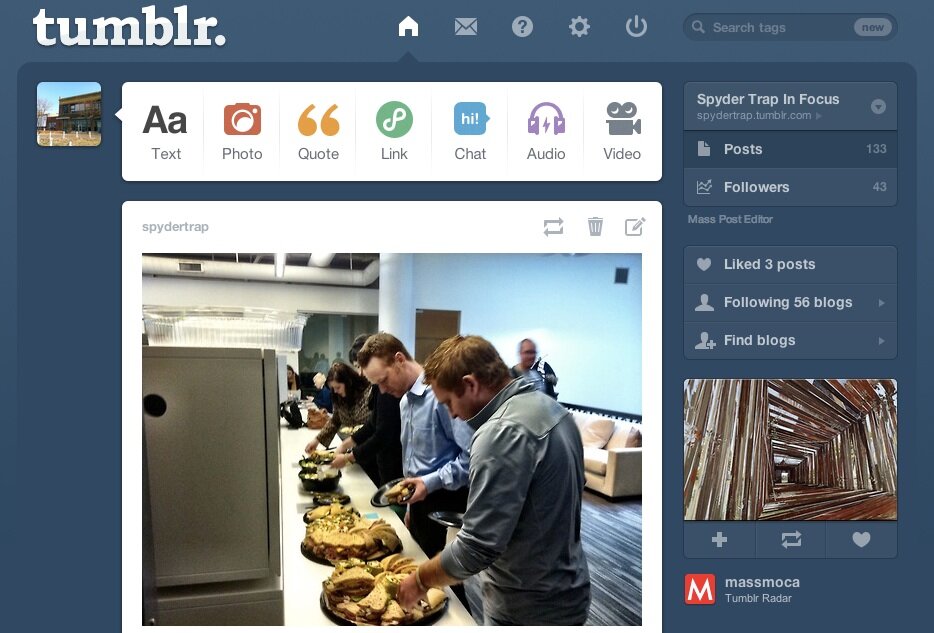
If the controlled chaos of Facebook and Twitter are the social media marketing gold standard, then Tumblr should be a nightmare for brand marketers. Tumblr’s intentional lack of user data, page insights and targeted advertising options can, and have, kept many brands from trying to establish a presence there.
With that in mind, Tumblr has one major advantage over most of the social media world: Volume. Tumblr now gets over 20 billion pageviews each month and is the number one social network for Americans under 25.
The end result is that despite the massive amount of activity and traffic on Tumblr, many brands are not leveraging it because of the lack of available data. In fact, Tumblr CEO David Karp recently acknowledged that a lot of brands just don’t get Tumblr.
Next Steps For Brands
As with any social media channel, Tumblr won’t be the right decision for every company. Tumblr’s content is dependent on visually-intensive imagery, much like an Instagram or Pinterest. If the resources to create that type of content isn’t there, then Tumblr may not be a good fit.
The other decision companies have to make before jumping in to Tumblr concerns reporting and analytics. Tumblr doesn’t allow you to access user data, or even see how your users’ number of followers. Furthermore, the page insights that social media marketers are so accustomed to won’t be available and this makes the traditional form of reporting incredibly difficult. While this shouldn’t be a deal breaker, it’s an important factor to consider.
So, who is Tumblr right for? Companies who are willing to prioritize being involved in the users’ conversation and the potential brand equity over the lack of data and statistics.
To revisit the zoo metaphor, Tumblr is the wild animal in the exhibit, unpredictable and difficult to control. On the other hand, it’s those same traits that make it interesting and appealing to an audience.
In an ever-expanding digital universe, Tumblr is the perfect example of a social media channel built to keep brands out. However, if a company understands that and develops a content strategy that plays into a user-focused mentality, it can potentially harness a largely untapped resource.
